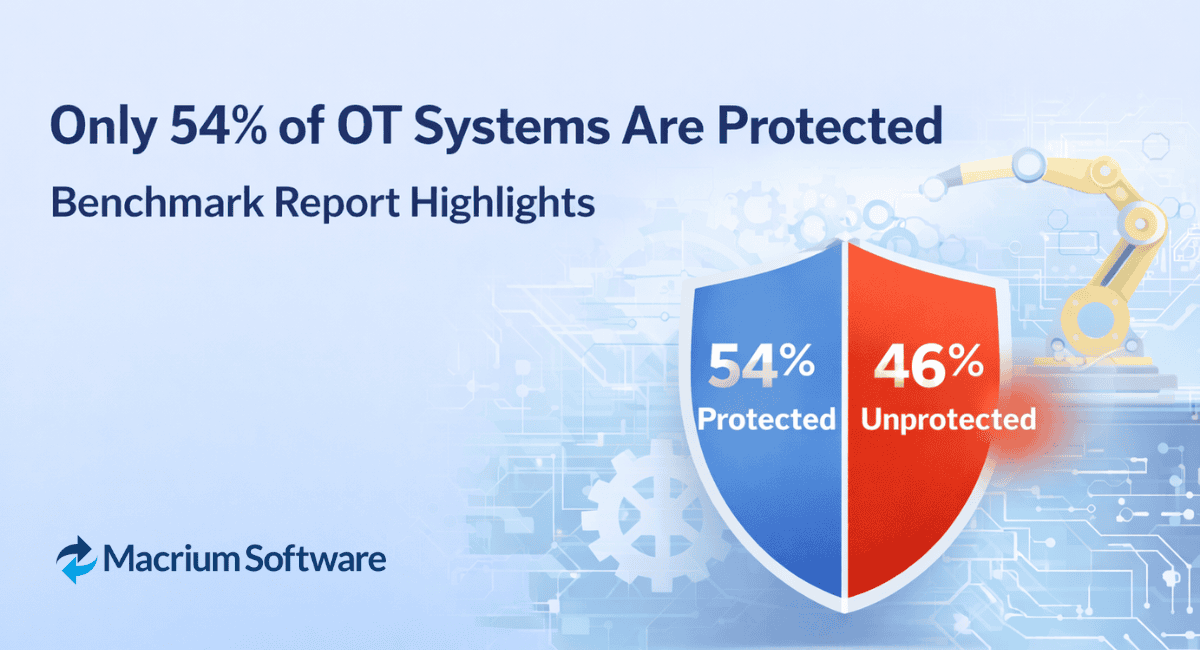
Only 54% of OT systems are protected, benchmark report finds.
Manufacturing resilience rarely fails in the data centre. When things go wrong, the problem is generally where production happens.
Yet Macrium’s recently published benchmark report, ‘State of Backup & Recovery in Manufacturing 2026’, highlights a stark imbalance at the heart of many resilience strategies. While most manufacturers have invested heavily in protecting IT workloads, only 54% of OT, ICS, and SCADA systems are backed up at all.
The shortfall, the lack of backup protection on almost half of all manufacturing systems, is critical. OT systems are not peripheral. They run production lines, control physical processes, and determine whether operations continue or stop.
Why OT is harder to protect than IT
The disparity is not, in the main, the result of neglect. Manufacturers understand the importance of operational technology, but OT environments are structurally harder to protect than standard IT estates.
Unlike IT systems, OT environments are shaped by constraints that cannot be wished away:
- • legacy hardware that cannot be upgraded or replaced easily;
- • long lifecycle requirements that stretch systems far beyond normal IT refresh cycles;
- • vendor lock-in and certification dependencies;
- • extremely limited maintenance windows;
- • safety and availability requirements that prioritise uptime over change.
In many plants, OT systems were designed to run continuously for years with minimal intervention. Recovery was not typically engineered as a rebuild-based process. Instead, resilience relied on redundancy, manual intervention, and operating models that deliberately minimised change.
As digitalisation has increased, those assumptions no longer hold. Failures now stem from configuration loss, maintenance errors, software faults, and integration issues. Yet recovery strategies have not always evolved at the same pace.
The legacy of IT-first resilience strategies
One reason that OT protection lags behind the rest of the estate is historical.
Most backup and recovery programmes were built around IT estates first. Databases, servers, cloud workloads, and endpoints were prioritised because they were visible, familiar and supported by mature tooling.
OT environments often sat outside those programmes. They were managed by different teams, governed by different priorities, and protected using ad hoc or inherited approaches. In some cases, systems were deemed too fragile or too risky to touch. In others, responsibility simply fell into the crevasse between IT and OT ownership.
What this resulted in was not neglect, but a structurally uneven approach to OT protection across the plant floor.
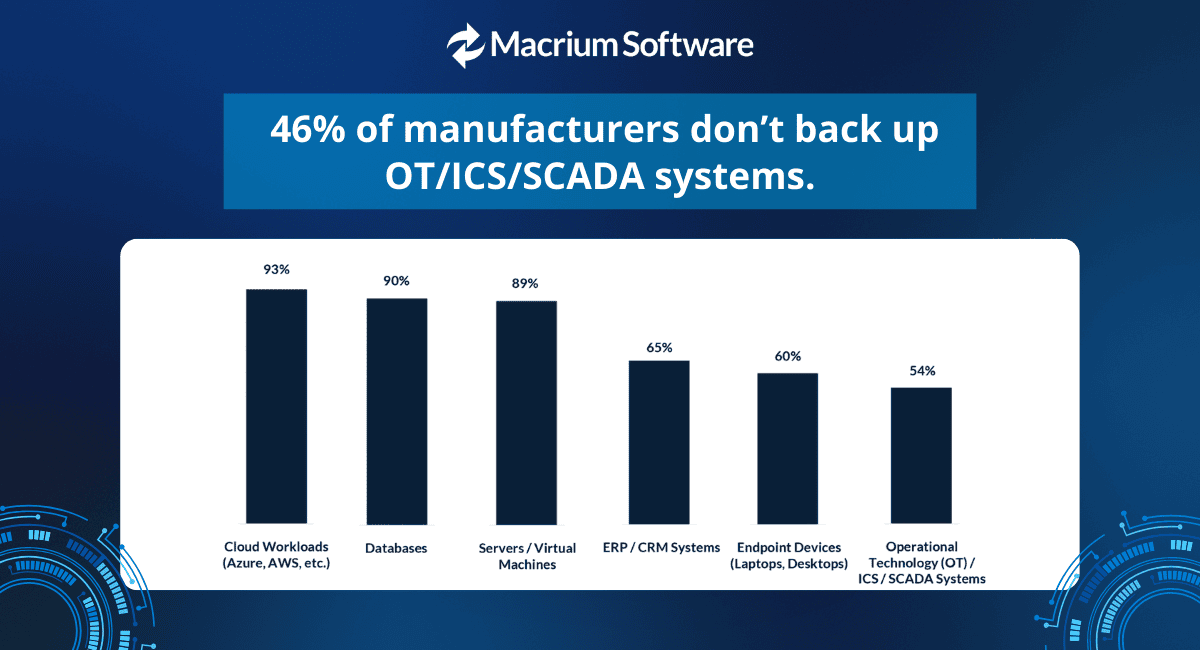
Why a 54% protection rate is not just interesting data
A protection shortcoming of this size is not an abstract metric. It has real operational consequences.
OT systems are directly responsible for:
- • production output;
- • quality control;
- • safety mechanisms;
- • coordination between machines and processes.
When these systems fail and cannot be recovered quickly, downtime is both immediate and costly. Production stops, schedules slip and manual workarounds are introduced, increasing risk and error.
The ‘State of Backup & Recovery in Manufacturing 2026’ report shows that manufacturers already experience frequent downtime, often driven by internal operational issues. In that context, running critical OT systems without backup coverage is not so much a calculated risk as an exposure that only becomes visible when recovery is needed.
As all manufacturing teams are well aware, OT downtime is business downtime.
Backup does not equal recoverability
Even where OT systems are backed up, recovery is not always assured.
Our report also highlights the gap between having backups and being able to recover reliably with only 18% meeting recovery targets. Testing is often infrequent, restore procedures are complex, and as a result confidence is commonly based on an assumption that everything will work, rather than proof that it actually will.
In IT environments, this gap is sometimes masked by automation and abstraction. In OT environments, it is amplified by system diversity and operational pressure. Recovery paths differ from machine to machine, and knowledge is often held by individuals rather than embedded in process.
This is why it’s vital that OT recoverability be treated as a distinct operational capability, not simply an extension of IT backup policy. Regular backup coverage is foundational, but only consistent validation confirms those systems can be restored reliably under real-world conditions. Without that proof, resilience remains an assumption rather than a demonstrated capability.
Treating OT recovery as a serious operational priority
Closing the OT protection gap is going to require a shift in mindset. Manufacturers will need to treat OT recoverability as a first-tier operational priority, on a par with safety, quality, and uptime.
Doing this means asking different questions:
- • Can this system be restored under real-world constraints?
- • How long will recovery actually take on this machine?
- • Can our operators execute recovery without specialist intervention?
- • Have we tested this recently, on this hardware?
These questions cannot be answered with IT-centric assumptions or generic tools alone. They require recovery engineered for the realities of the plant floor.
Engineering recovery for constrained environments
As manufacturing teams often point out, successful OT recovery depends on solutions designed for constrained environments rather than adapted from enterprise IT models. This is the context in which Macrium operates.
By supporting recovery across legacy-to-modern systems, long lifecycles, and constrained or disconnected networks, manufacturers can move beyond theoretical protection to proven recoverability.
Macrium’s experience in full system imaging informs that approach. Rather than focusing on abstract backup completion metrics, the emphasis is on restoring systems to a known-good operational state, predictably, when disruption occurs.
This matters most where systems cannot be easily replaced, where connectivity cannot be assumed, and where downtime carries immediate business impact.
Strengthening the weakest link
Manufacturers do not need to rebuild their entire resilience strategy from scratch. But they do need to address its weakest link.
The benchmark data makes it clear that the plant floor continues to be that link. Until OT systems are consistently protected, tested, and recoverable under real-world conditions, resilience will remain uneven - no matter how advanced IT recovery becomes.
Closing that gap often requires a specialist approach. OT environments are long-lived, operationally sensitive, and frequently disconnected. Recovery tooling must prioritise stability, deterministic restore behaviour, and lifecycle alignment - not platform breadth.
Macrium is designed around those constraints. Reflect LTSC aligns with long-lived operational assets where change is tightly controlled, and solutions such as SiteBackup provide oversight across distributed plants and multi-site operations without introducing unnecessary complexity into the recovery path.
The opportunity is not just to increase coverage, but to increase confidence. To move from “this should work” to “we know this will recover.”
Explore the report in full
These findings are explored in depth in our ‘State of Backup & Recovery in Manufacturing 2026’ report, which examines how manufacturers are balancing complexity, risk, and recovery performance across IT and OT.
If you’d like to understand where backup simplification can reduce OT exposure, and how your approach compares with industry benchmarks, download and read the report for yourself or you can reach out to our OT experts directly for an evalutation of your current strategy.
Author: Brooke Watson, Content Marketing Manager, Macrium

Previous Post
Manufacturing Downtime Mostly Caused by Operational Failures, Not Cyberattacks, Study Finds
Next Post
New Research Finds Manufacturers Falling Short on Recovery Speed | 2026 Manufacturing Report