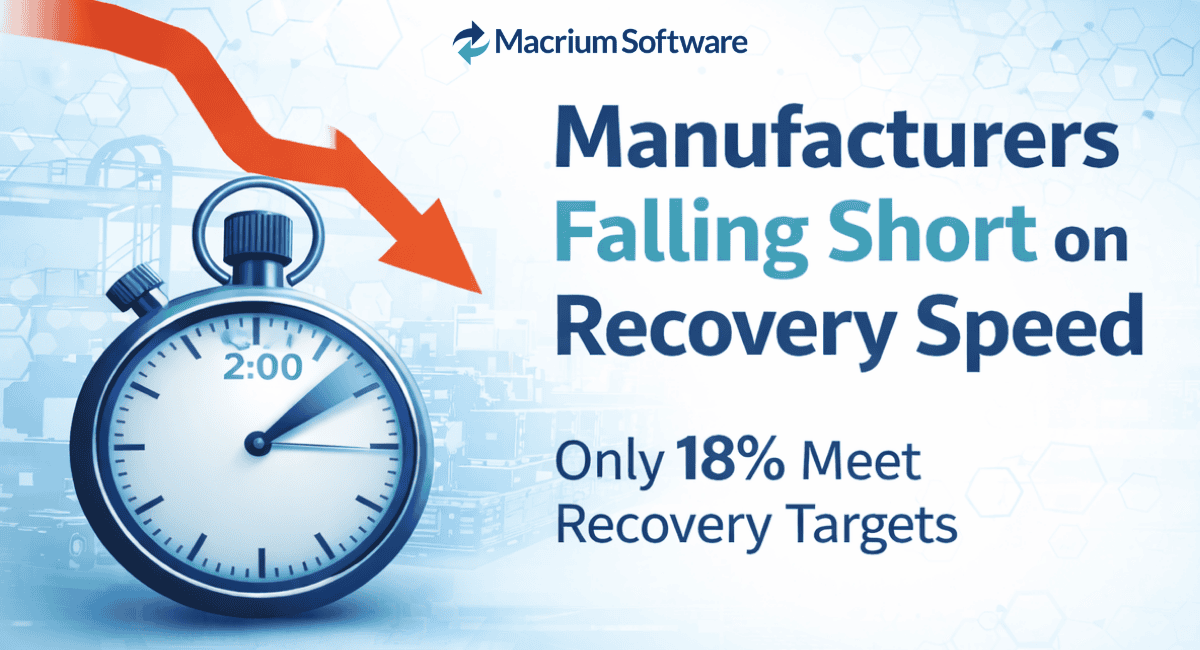
Recovery speed is the real resilience test, and many manufacturers are falling short, new research suggests
According to Macrium’s 2026 State of Backup & Recovery in Manufacturing report, true resilience isn’t measured by how many backups you have – it’s defined by how quickly you can recover when something goes wrong.
The benchmark research behind the report shows a sobering gap between perception and reality. While most manufacturers believe they can restore critical systems within their planned timeframes, only 18% actually meet or exceed those targets. Three‑quarters of organizations need more than two hours to resume operations after an outage. In a sector where downtime can cost six‑figure sums per hour, recovery speed is the difference between a minor disruption and a crisis.
Why does recovery speed matter more than backup coverage?
Backup coverage answers a simple question: do we have a (reliable) copy of the system somewhere? Recovery speed, in contrast, answers a much more consequential question: how quickly can we resume production when something goes wrong? In manufacturing environments, the distinction is crucial.
OT systems control physical processes and don’t degrade gracefully – they stop. Every minute of downtime impacts output, delivery commitments, safety and customer confidence. That’s why Macrium focuses its research on recovery speed, not just backup adoption – because having copies is meaningless if you can’t restore them predictably and fast.
What causes the gap between planned and actual recovery times?
Many recovery plans are inherited from IT‑centric thinking, where virtualization, templated builds and automation make restores relatively predictable. OT environments behave very differently: systems are tied to specific hardware, configurations are bespoke, and some machines haven’t been rebuilt in years.
Planned maintenance windows are short and taking a machine offline to test recovery procedures is difficult. Under pressure, small frictions – finding the right image, validating configurations, coordinating access across IT, OT and operations – compound into hours of downtime. The research highlights that complexity and coordination, not lack of care, are the primary reasons recovery takes longer than expected.
How much does downtime cost manufacturers?
Downtime costs scale quickly. The report found that nearly half of respondents in North America and more than a third in the UK estimate downtime costs exceeding $100K per hour. Initial disruptions may seem manageable, but delays cascade as production schedules slip, manual workarounds proliferate and downstream processes are affected. In that context, even modest recovery delays have outsized consequences.
Why is recovery a coordination problem as much as a technical one?
The benchmark data underscores that recovery speed is constrained as much by people and process as by tooling. OT recovery typically involves multiple teams operating under pressure, with responsibilities split between IT, OT, engineering and operations.
That fragmentation slows decision‑making when ownership is unclear or when recovery depends on specific individuals with deep system knowledge. During incidents, uncertainty becomes its own delay: teams pause to confirm assumptions, validate next steps or wait for approval. Each pause adds minutes that become hours.
Does testing improve recovery confidence?
Testing frequency is one of the clearest signals of recovery confidence. While two‑thirds of manufacturers review performance metrics monthly or quarterly, only 60% perform full disaster‑recovery exercises twice per year or annually.
Many organisations assume they can meet their recovery time objectives without actually validating that assumption. When procedures remain untested, teams move cautiously during incidents, extending downtime.
Engineering recovery for complex OT environments
Improving recovery speed requires a shift in mindset: treating recovery as an engineered operational capability rather than an implied outcome of having backups. That means designing processes that account for legacy hardware and system dependencies, restoring complete systems, not just data, that behave consistently across similar machines and can be executed reliably by teams under pressure.
It doesn’t mean collapsing IT and OT into a single recovery model – it means acknowledging that OT recovery operates under different constraints and designing accordingly.
Macrium’s perspective – purpose‑built imaging for predictable OT recovery
Macrium Software specialises in backup and recovery for operational technology and mixed environments. Our solutions are built around three pillars:
- Fast, proven, predictable recovery – validated system images that restore complete environments within their promised timeframes.
- Engineered for complexity – solutions that behave consistently across bespoke configurations, legacy hardware and constrained environments.
- Imaging is in our DNA – full‑system imaging and bare‑metal restore as the foundation of recovery, not an afterthought.
For manufacturing teams, this specialist focus translates into deterministic recovery paths and greater operational confidence. Rather than treating OT like a slower version of IT, our tools validate that recovery will work under real‑world constraints. That’s why we invest in benchmark research like the State of Backup & Recovery in Manufacturing – to provide real-world data‑driven insights and to inform the design of solutions that close the gap between expectation and reality.
Macrium backup and recovery experts work directly with manufacturing organisations to assess risk, validate recovery timeframes, and design resilient strategies tailored to complex environments. Speak to the team to discuss your backup and recovery strategy.
Closing the recovery gap and next steps
This research makes it clear that resilience isn’t proven by the presence of backups alone. It’s demonstrated by how quickly and predictably systems can be restored when disruption occurs. Manufacturers need to design recovery processes for the realities of OT, test them regularly and ensure that coordination isn’t the bottleneck. By doing so, they can reduce the operational and financial impact of downtime and move from reactive to engineered resilience.
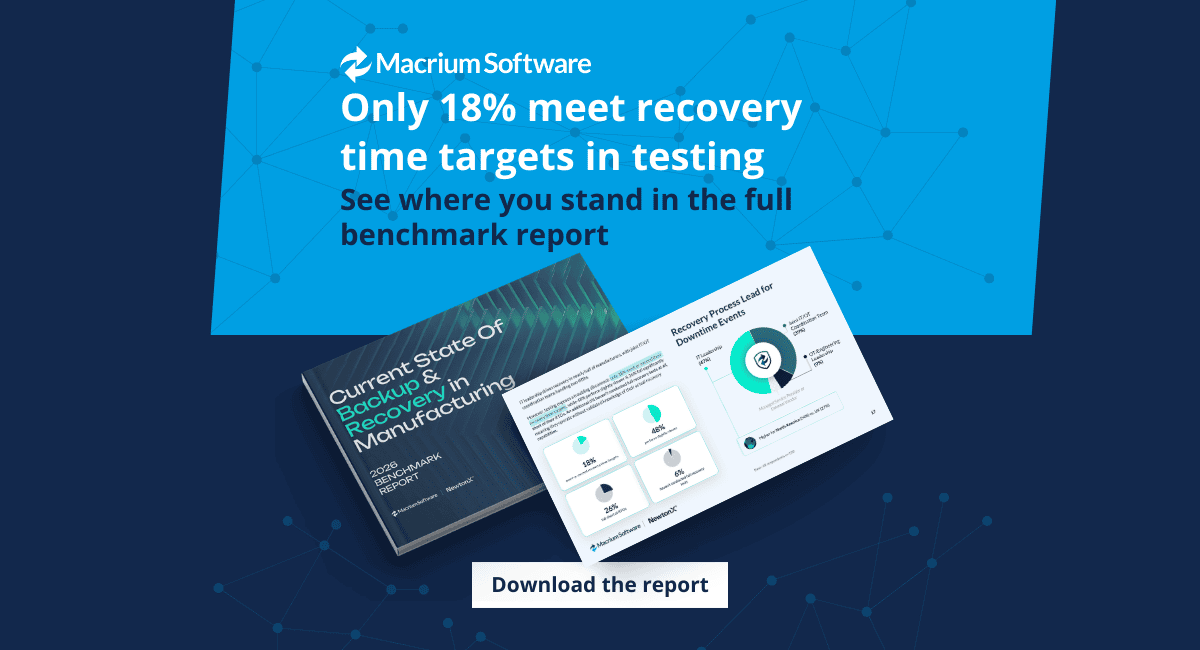
For a deeper dive into the benchmark data – including detailed recovery time distributions, downtime cost exposure and regional comparisons – download the full 2026 State of Backup & Recovery in Manufacturing report. It offers a comprehensive look at where the sector stands today and what leading manufacturers are doing to close the gap between expectation and reality.
Author: Brooke Watson, Content Marketing Manager, Macrium
Previous Post
The OT Protection Gap: Why 46% of Manufacturing Systems Remain Unprotected | 2026 Manufacturing Report
Next Post
Why backup validation is the most overlooked part of OT disaster recovery